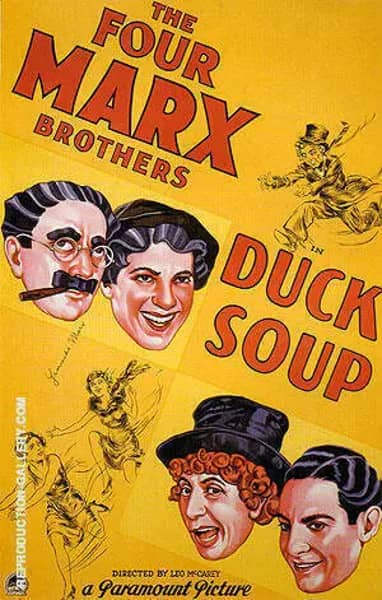
Because it wouldn’t be a proper comedy blog without stupid puns, right?
Anyway, there’s a reason why I chose this movie as my first post. A lot of them, actually. It’s one of the earliest movies to make me laugh out loud (save for Sherlock Jr., but I figured silent film will have its own time in the sun on this blog). The Marx brothers’ reputation precedes them, of course, to the point where the stock glasses imitating Groucho Marx are considered synonymous with comedy itself. But the biggest reason is that I specifically remember the first time I watched it, which I don’t always do.
I was at my parents’ house between semesters at college, and my dad had been on an old movie kick. He has a bit of a different taste than me, leaning more into musicals and early 20th century comedy (I’m more into dark humor and 70s-90s films myself), so I wasn’t particularly interested in joining him. One day I happened to see in passing that he had Duck Soup on. Like most people, I was aware of the Marx brothers as a cultural phenomenon, but I hadn’t actually seen them in action before. The movie had just started, and my interest in film history was just beginning, so I decided, “eh, why not. I’ll stay for a scene or two.”
I “just one more scened” myself into watching the entire thing, because the Marx brothers in this nearly century-old movie were just that compelling. That was when I first began to notice the precision and practice required to master comedy.
We’ll get to the brothers themselves later, but first I want to discuss the film itself, because if I start with the brothers, we’ll be here all day. Duck Soup follows Rufus T. Firefly (Groucho Marx), the new president of the fictional country Freedonia, and Sylvanian spies Pinky (Harpo Marx) and Chicolini (Chico Marx). Sylvania is also another fictional country, and one embroiled in a conflict with Freedonia. With oft-forgotten brothers Zeppo playing Firefly’s secretary and Gummo focusing on talent management behind the scenes (as was his main priority after the brothers’ vaudeville years), this film completed the transition of vaudeville from the stage to the silver screen.
Now that that’s out of the way, let’s talk about the men behind the laughs. There may be no greater example of the double-sided nature of funny business than the story of Chico, Harpo, and Groucho. While they are most known for their films, the three brothers (along with brothers Gummo and Zeppo, whose participation in the troupe varied over the years) started in vaudeville, a type of theatrical entertainment that would involve various forms of performance in one show. Vaudeville faded from the zeitgeist after the advent of film, but many well-known vaudeville performers transitioned gracefully into comedy and musical film, which at that point were typically considered one and the same.
Despite their legacy as a family team, the Marx brothers’ relationship was marred by hardship. Born into poverty, the Marx brothers entered vaudeville by the time they were teenagers. With Chico supposedly the parents’ “favorite” (according to sources of varying credibility), Groucho was the first to become a performer at only fourteen. The brothers followed suit to earn their family some extra money, and before long they were a nationwide sensation.
Because I want to focus on comedic devices and iconic moments, that’s a gross oversimplication of the Marx brothers’ backstory. In the previous paragraph, I have linked a blog that puts it much better than I do, while I focus on what we’re here for. Here are some of (what I consider) the moments that made Duck Soup’s legacy last this long.
Here we see Groucho Marx’s rapidfire comedy chops, a staple of the Marx brothers’ comedy. Barely leaving time for his counterpart to respond or even process his words, Groucho’s quips are more for himself and the audience than anyone else. Furthermore, we see the ending of the opening musical number, in which much literal and metaphorical fanfare is given for Freedonia’s new president… who happened to oversleep and totally miss his grand entrance. When the woman ignores Firefly’s late entrance and praises him all the same (all in a very exaggeratedly formal accent even for the time), Firefly merely uses her as a sounding board to amuse himself and the audience. We see several scenes like this in Duck Soup and other Marx brothers film, and it’s often what people think of when the term “Marx” is brought up. In a comedy context, at least.
The previous scene is to say nothing about the other Marx brothers’ chops. Harpo, Chico, and Zeppo show their own sense of physical and verbal comedy. With Zeppo playing the straight man, Harpo and Chico play the spies infiltrating Freedonia, only to show that they are totally inept and have no idea how to read the room. Chico mirrors Groucho’s style of rapidfire comedy along with Harpo, who instead uses physical comedy and sound effects. Harpo was known as the silent brother, but contrary to popular belief, this was not because he was mute, had anxiety, or any other disability. No, Harpo Marx’s pantomime was simply so great that he decided to lean fully into it and leave the spoken comedy to his brothers. This proved vital to Harpo developing his own distinct sense of humor and setting him apart from his brothers.
This is perhaps Duck Soup’s most famous scene, and my personal favorite. Falling back on the humor of silent films, the audio cuts out entirely as Firefly attempts to catch Pinky (disguised as Firefly) in the act of espionage. Firefly knows that something’s amiss, but for some reason feels he can’t break character until he catches Pinky not mirroring his actions. Even as the two walk to either side of the “mirror,” and even after Pinky drops his hat and Firefly picks it up for him, it’s not until Chicolini appears (also disguised as Firefly) that they’re ultimately caught. The absurdity of this scene in concept is already hilarious, and the comedic timing and expressions of Groucho and Harpo cement it as one of the most iconic scenes in comedy.
In terms of legacy, Duck Soup really speaks for itself. References to Groucho abound in both written comedy and iconography (imitated in characters like Bugs Bunny and Yakko Warner), but this isn’t to say the other brothers are chopped liver. Harpo’s pantomime and nonverbal sound comedy has been imitated in various cartoons (most prominently Tom and Jerry). Chico’s reputation has not received the same loving tributes, but he is still remembered as a vital member of the original trio.
This is the part where I’d planned to put a final joke, but I haven’t really thought of one. I thought of two, three, four, and eighty-six, but not one. I’d imitate Groucho’s fast-paced quips, but that doesn’t seem like any pun– er, fun. It doesn’t work as well in a written context, but con text really explain anything well? Well, I might have to quip talking altogether. Quit talking, I mean. Yes, you, I can’t get a word in edgewise here. Can’t you see what I’m trying to tell you? I love you!
-Eli


Leave a Reply