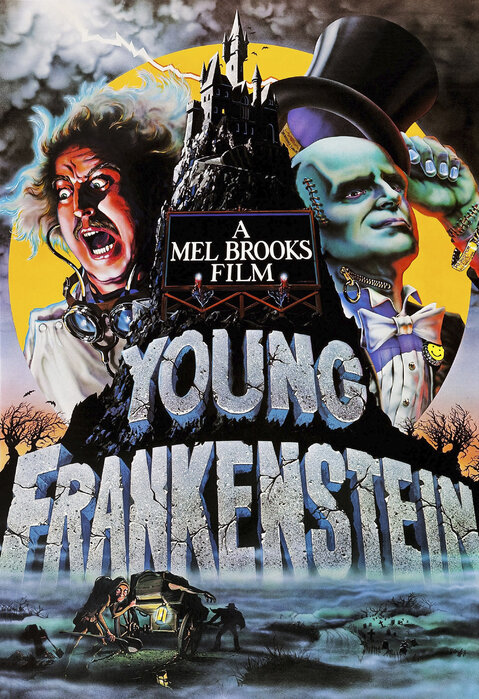
When it comes to Mel Brooks films, it’s hard to choose just one to cover for this blog. The easy answer is to start at the beginning with 1967’s The Producers. However, the inflammatory Blazing Saddles is also a solid pick, as well as the cult classic Spaceballs. However, I wanted to pick a film that’s near and dear to my heart, plus it allows me to talk about satire in relation with the other genre I’m currently obsessed with: horror.
A different blog might choose Scary Movie or Jordan Peele’s filmography to discuss the relationship between comedy and horror. Fine choices both, but not quite for me. To me, no conversation about horror comedy (or comedic horror, for that matter) is complete without Young Frankenstein.
In the 1974 tribute to German expressionist cinema, Mel Brooks presents a retelling of Frankenstein in a more optimistic light. Victor Frankenstein’s grandson, Frederick (Gene Wilder), is a biology professor who lives in shame of his grandfather’s work. However, when he inherits the Frankenstein estate in Transylvania, Frederick’s interest in the infamous Frankenstein project is (if you’ll forgive the pun) resurrected. With his assistants Igor (Marty Feldman), Inga (Teri Garr), and Frau Blucher (Cloris Leachman), Frederick successfully reanimates the Monster (Peter Boyle). Naturally, in line with the Frankenstein tradition, things spiral out of control when the housekeeper, Frau Blucher (Cloris Leachman), sets the monster free, only made more chaotic when Frederick’s fiancee Elizabeth (Madeline Kahn) visits.
While not all these characters are necessarily integral to the plot, I’d be remiss not to mention the absurdly talented and hilarious performances from each and every one of these actors. They clearly understand German expressionism and the classic horror movies that spawned from it, while balancing Mel Brooks’ more contemporary comedic wit. Brooks had been working with Wilder since their first film (both together and in general), The Producers, which also focuses on Mel Brooks’ sense of satire and love of musical theater. If you don’t see what musical theater has to do with Frankenstein, don’t worry, we’ll get to that.
This scene introduces Igor, allowing Gene Wilder wit to spar against Marty Feldman’s absurdist sense of humor. While this scene has several great moments (“it’s pronounced eye-gor”) and gives a faithful tribute to early horror cinematography, there is one specific moment I want to point out in this scene: When Igor leads Frederick down the stairs and tells him to “walk this way.”
This was because of an in-joke on set inspired by Monty Python’s Flying Circus, and originally, both Wilder and Feldman wanted the line cut from the film. Mel Brooks refused because he thought it was too funny to leave out. Audiences agreed, including the band Aerosmith. In what admittedly sounds like an urban legend, Aerosmith had hit a writer’s block while recording for the album Toys in the Attic, and ended up watching Young Frankenstein during their break. The “walk this way” joke stood out to them as especially funny, and guitarist Joe Perry decided to use it as the hook for the song.
This scene shows the relationship with Frederick and the Monster, subverting the relationship in the traditional Frankenstein story. While Frederick is naturally terrified of the Monster at first, he does not loathe his creation as most iterations of Victor Frankenstein do. Instead, he leans into flattery, showing the Monster love and compassion for the first time in his short (return to) life. This moment is not just humorous, but also a deeply moving moment for both Frederick and the Monster. While Frederick was cynical and unsentimental at the beginning of the movie, his approach toward the Monster softens as Frederick starts to view him as a son.
This blog may focus on comedy predominantly, but sentimental moments such as these make the comedy hit even harder. Furthermore, it plays into the traditional definition of a comedy; that is, Young Frankenstein gives both scientist and creation the happy ending they never had before.
Like with my post on Duck Soup, I saved the best for last. This is one of the most iconic scenes of Young Frankenstein, showing of Mel Brooks’ distinctive style of comedy and performance. Frederick Frankenstein shows the Monster to the townsfolk in an attempt to make them forget about his grandfather’s failed attempt, and instead welcome the Monster with open arms. After showing a display of simple motor functions, Frederick puts on a choreographed number to “Puttin’ on the Ritz,” allowing the Monster to dance along and slur the titular hook. It’s a charming scene, both to the audience in real life and the townsfolk, until a bulb on the stage breaks and upsets the Monster. Although the performance goes sideways, it’s a memorable moment in the film that reminds the audience to not take the premise too seriously.
Similarly to the “walk this way” scene, the “Puttin’ on the Ritz” scene was Gene Wilder’s idea, and Mel Brooks had initially shut it down. Wilder himself goes into more detail about their rare conflict here.
If I could, I would include every scene from this brilliant movie, but this post is getting pretty long already. When I first showed Young Frankenstein to one of my friends, I caught myself saying “Ooh, this is a good scene” before just about every scene. Aside from making me an apparently annoying friend to watch movies with (I’ve since learned to keep my mouth shut), I feel this speaks to how iconic Young Frankenstein has become. Did I pick this film to review predominantly because of my own personal nostalgia for it? Yes. Is it still a stone-cold classic that holds up (as much as a film from 1974 can hold up, at least) and that I recommend to anyone reading this? Also yes.
-Eli


Leave a Reply