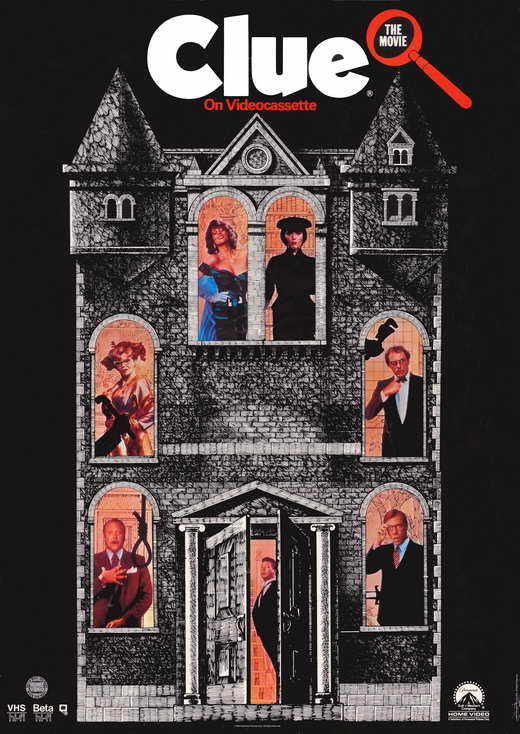
I used to play a ton of board games. Or I’d try to, but my folks were never interested. Despite that (or maybe because of it), I never actually played Clue. I knew of it, of course, and I dabbled in my fair share of mysteries. Those two interests just never crossed paths.
I never watched the film version of Clue either, despite constantly hearing how great it was. I’d seen Murder by Death (1976), an earlier version of a similar concept featuring caricatures of different fictional detectives with varying racial tact. Foolishly, I thought Clue would be a rehashing of the same concept. While they are similar and Murder by Death does have its moments (namely, any time Peter Falk is onscreen), Clue proves more timeless in its humor, sensibilities, and as a standalone feature.
Unfortunately, it took the recent passing of Tim Curry for me to watch Clue. Although he’s most remembered for the glamorous Dr. Frank-N-Furter, let it not be said that it was his only notable role. Tim didn’t become an omnipotent clown demon in IT, a Soviet doctor in The Hunt for Red October, a grizzled pirate in Muppets Treasure Island, Nigel “Smashing” Thornberry, and countless others just to be remembered for one (albeit also fantastic) role.
But we’re not here to talk about any of those characters. We’re here to talk about a humble butler.
In Clue, Tim Curry plays the loyal (?) butler Wadsworth, and in doing so, allows the cast to give some of their greatest comedic performances, including his own. Alongside stars like Madeline Kahn and Christopher Lloyd, Curry turns in a memorable performance as the deadpan fast-talking butler who arranges the game’s infamous dinner party. In line with the game, each character in the film is invited to the party by the mysterious Mr. Boddy, and subsequently given a colorful pseudonym. Mr. Boddy reveals that he has blackmail material on all the guests, after which he is found dead.
The following mystery leads the audience on a wild goose chase down to the very end. When Clue was released in theaters, an ending was randomly selected out of three, so no two viewing experiences would be alike. Unless you happened to get the same ending twice in a row, but you get it. Fortunately, in home and streaming releases, not only are all three endings included, but they are arranged in order of least to most likely, so we finally know what the “true” ending is.
Typically, I would refrain from spoiling the ending of the films I discuss, but considering my three-clip format and that this movie has three endings, this opportunity is too good to pass up.
For those unfamiliar with Clue, the first thing that will stand out is the rapid-fire humor and line deliveries. Each character gets at least a few lines in group conversation scenes, and with six guests and Wadsworth, it can often feel busy. At the same time, it doesn’t feel rushed, and having watched the film up to this point, these characters are distinct enough that none of them or their lines feel irrelevant.
What some may find interesting about this ending (or, at least I did, anyway), are the allusions made to Miss Scarlet (Lesley Ann Warren) being a prostitute, when the word itself is never actually said. While I couldn’t find a direct reason why this choice was made, I have two theories: The first is to secure a PG rating, or to stay in line with the original game, which was rated G. The second is that the film itself takes place in 1954. With Miss Scarlet’s defensiveness over her profession and the general squeamishness around sex at the time, it’s no wonder the actual word would be avoided.
In this scene, Mrs. Peacock (Eileen Brennan)’s nervous facade drops as she is exposed as this ending’s killer. The script digs into the political satire all the deeper, repeating the line about communism being a “red herring.” This line is present in all endings, as well as the notion that the killer was in it for blackmail and political power. We also see Clue’s more absurd sense of humor (such as Mrs. White (Madeline Kahn)’s angelic harmonies as the guests are made to sing “For She’s a Jolly Good Fellow” at gunpoint), and throwbacks to vaudevillian miscommunications (“Mrs. Peacock was a man?!”)
In the final ending, Wadsworth comes to the canonical answer; every guest has blood on their hands, himself included. The butler takes the guests on a frantic chase around the mansion to reenact how each murder happened. It does disappoint me that the funniest and most popular part of this movie is in only one of the three endings, but perhaps that’s what makes Madeline Kahn’s nonsensically angry monologue all the more special. According to Michael McKean (the actor behind Mr. Green), this moment was entirely improvised by Kahn, making the other guests’ perturbed reactions genuine.
Speaking technically, although each guest is responsible for a murder, Wadsworth being the “Mr. Boddy” behind the letters means that he orchestrated the whole thing, and thus the blood would be on his hands. Furthermore, this would mean only Mr. Green’s murder was justified, allowing his mild-mannered, closeted gay persona to drop in one badass moment. He explains who killed Mr. Boddy in classic Clue fashion (“I did, in the hall, with the revolver”), and proceeds to emphasize that the character he was putting forth was, indeed, a character in possibly one of the best ending lines in film history.
When I first watched Clue with my friends in memory of Tim Curry, one of them described its sense of humor perfectly: “The joke-per-minute ratio is off the charts.” While the rest of the movie takes its time building suspense as the guests investigate the various murders, there are moments like the three endings in which jokes are shot off faster than you can process the last. Usually this would be a criticism of the film’s pacing, but given how consistently each joke hits, it just adds to the film’s replay value.
If you only watch one film I’ve written about, please watch Clue. You won’t regret it. Do it for Tim.
-Eli


Leave a Reply